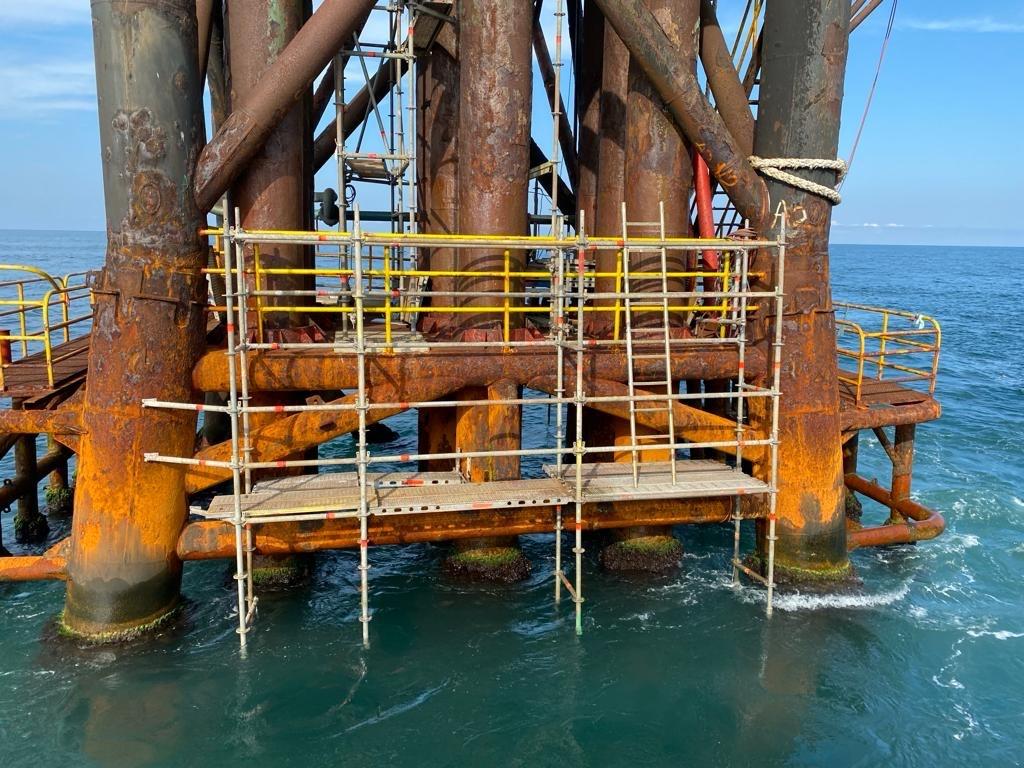
Corrosion Behavior of Steel in Marine Environments
Mechanisms, Factors, and Prevention Methods
Keywords:
Steel Corrosion, Marine Environment, Corrosion Behavior, Protective Coating, Cathodic ProtectionAbstract
Steel is widely used in marine structures due to its high strength, availability, and relatively favorable mechanical properties. However, exposure to seawater makes steel susceptible to corrosion, which can reduce structural integrity, service life, and operational reliability. This article discusses the corrosion behavior of steel in marine environments by examining its mechanisms, influencing factors, and prevention methods. The discussion focuses on common corrosion mechanisms, including uniform corrosion, pitting corrosion, and galvanic corrosion, as well as the effects of salinity, dissolved oxygen, temperature, pH, and seawater exposure on corrosion development. Various corrosion prevention methods, particularly protective coatings and cathodic protection, are also reviewed. The results indicate that marine corrosion is influenced by the interaction between steel surfaces and environmental conditions, with seawater characteristics playing an important role in corrosion development. Proper material selection, surface protection, regular inspection, and appropriate corrosion control methods are essential for maintaining the durability and reliability of marine steel structures. Effective corrosion management can reduce material degradation, extend structural service life, and improve the safety and sustainability of marine infrastructure.
References
[1] H. Tian et al., “Corrosion evolution and stress corrosion cracking behavior of a low carbon bainite steel in the marine environments: effect of the marine zones,” Corros. Sci., 2022, doi: 10.1016/j.corsci.2022.110490.
[2] H. Zhang et al., “The effect of immersion corrosion time on electrochemical corrosion behavior and the corrosion mechanism of eh47 ship steel in seawater,” Metals (Basel)., vol. 11, no. 8, 2021, doi: 10.3390/met11081317.
[3] P. Liu, H. Zhang, Y. Fan, and D. Xu, “Microbially Influenced Corrosion of Steel in Marine Environments: A Review from Mechanisms to Prevention,” Microorganisms, vol. 11, no. 9, 2023, doi: 10.3390/microorganisms11092299.
[4] P. Li and M. Du, “Effect of chloride ion content on pitting corrosion of dispersion-strengthened-high-strength steel,” Corros. Commun., vol. 7, pp. 23–34, 2022, doi: 10.1016/j.corcom.2022.03.005.
[5] Y. Xu, Y. Huang, F. Cai, D. Lu, and X. Wang, “Study on corrosion behavior and mechanism of AISI 4135 steel in marine environments based on field exposure experiment.,” Sci. Total Environ., p. 154864, 2022, doi: 10.1016/j.scitotenv.2022.154864.
[6] R. Xia, C. Jia, and Y. Garbatov, “Deterioration of marine offshore structures and subsea installations subjected to severely corrosive environment: A review,” Mater. Corros., vol. 76, pp. 758–775, 2024, doi: 10.1002/maco.202314050.
[7] D. Chen, W. Guo, B. Wu, and J. Shi, “Service life prediction and time-variant reliability of reinforced concrete structures in harsh marine environment considering multiple factors: A case study for Qingdao Bay Bridge,” Eng. Fail. Anal., 2023, doi: 10.1016/j.engfailanal.2023.107671.
[8] T. Chen et al., “Atmospheric Corrosion Behavior of Q235 Steel Exposed to the Subtropical Marine Environment in the East China Sea for Two Years,” Materials (Basel)., vol. 19, no. 6, pp. 1–18, 2026, doi: 10.3390/ma19061189.
[9] Z. Wang, L. Jin, P. Liu, X. Liang, and T. Wu, “Three-point bending performance of carbon steel with random pitting corrosion in marine environments,” Case Stud. Constr. Mater., 2025, doi: 10.1016/j.cscm.2025.e05740.
[10] R. E. Melchers, R. Jeffrey, I. A. Chaves, and R. B. Petersen, “Predicting corrosion for life estimation of ocean and coastal steel infrastructure,” Mater. Corros., vol. 76, no. 6, pp. 776–789, 2025, doi: 10.1002/maco.202314201.
[11] K. M. Douglas and R. M. Sutton, “Kent Academic Repository,” Eur. J. Soc. Psychol., vol. 40, no. 2, pp. 366–374, 2010.
[12] Q. Ouyang, J. Rao, and C. Guo, “A Weibull Distribution-Based Corrosion Rate Model for Intelligent Monitoring of Steel Structures in Marine Splash Zones,” Sensors, vol. 26, no. 4, pp. 1–24, 2026, doi: 10.3390/s26041401.
[13] G. Dalmora, E. P. B. Filho, A. A. M. Conterato, W. S. Roso, C. Pereira, and A. Dettmer, “METHODS OF CORROSION PREVENTION FOR STEEL IN MARINE ENVIRONMENTS: A REVIEW,” Results in Surfaces and Interfaces, 2025, doi: 10.1016/j.rsurfi.2025.100430.